

Many months ago, a friend on Substack proposed a challenge: read all the novels on that year’s Booker Prize longlist.
The Booker Prize is, according to its own definition, the leading literary award in the English-speaking world, honoring the best sustained work of fiction published each year.
A collective reading project of the curated list of the best novels of the year sounded appealing.
I approached this challenge expecting to be confronted with different styles, voices, and themes putting my own reading habits to the test against a broader literary field (recently I stuck to science fiction). In that sense, I was not disappointed.
I began reading keeping in mind that what makes a book “the best” is debatable. After all, reading is too personal. Instead of judging these novels by some universal standard, I asked myself a few simple questions:
Pleasure. Did I actually want to keep reading, or did I just feel obligated to? Would I recommend this book to a friend?
Voice. A book can be competently written but unappealing at the same time. Did the writing style default to a familiar register or did it feel authored, distinctive?
Impact. When the reading ended, what remained? Was there anything memorable about it? A scene, a sentence, a message, anything at all that justified the time spent with the book?
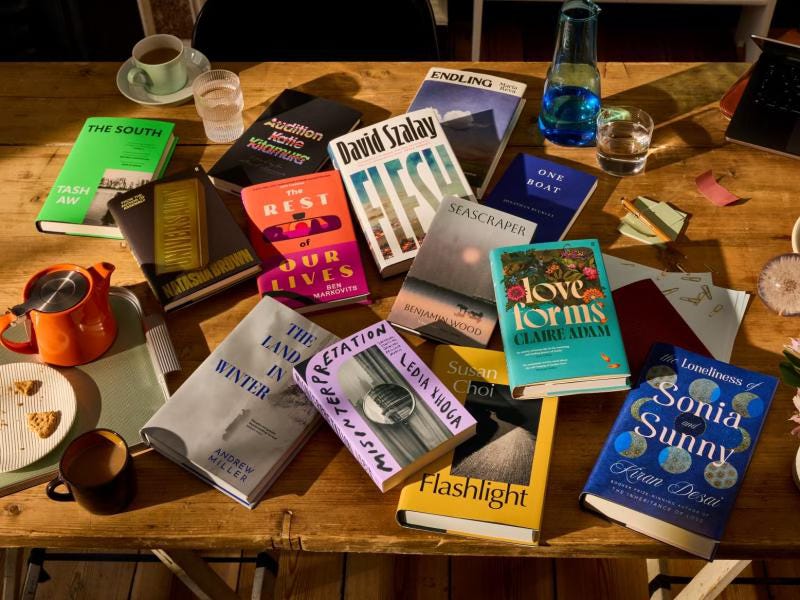
Disclaimer: I didn’t finish every book on the longlist. In a context where “the best of the year” is the claim, a novel’s inability to hold a willing reader’s attention is not incidental. Fatigue, resistance, and abandonment are part of the reading experience, and I’ve treated them as such.
1/13 - Misinterpretation by Ledia Xhoga
The novel opens with a promising setup: an Albanian immigrant in New York helping other Eastern Europeans navigate work, paperwork and, more generally, survival in America.
The story revolves around daily interactions the protagonist has with her loose social circle and her relationship with her husband. Unfortunately, their dynamic never clicks. The characters feel mismatched beyond what the novel explores or justifies, creating a constant low-grade confusion.
In the second half, the novel attempts an arc by pivoting into fantasy. A sudden, impulsive return to Albania briefly suggests a reckoning or a search for grounding. Instead, the narrative collapses into contrivance. The husband appears as if summoned by plot convenience. Their conflict resolves without having been meaningfully developed. The prose is serviceable and largely unadventurous.
Simply put, the first half built expectations the second half didn’t meet.
2/13 | Seascraper by Benjamin Wood
This novel won me over immediately. We follow a young man working as a seascraper, moving through days defined by physical labor, exhaustion, and limited horizons. The narration is intimate and settles into a cozy rhythm.
The protagonist, worn down by a harsh life, doesn’t complain. Instead, the novel lets his inner life surface through small gestures, most notably his secret devotion to music. There is a tenderness in the way he relates to his horse, encouraging it through sheer presence and care, that reveals more about his character than any backstory could.
The character feels genuine and his suffering is not shown for effect. His arc is worthy of Twin Peaks (the original). I won’t spoil it because it’s simply superb.
By the time the story ends, what remains isn’t a plot twist or a thesis, but a person. A dignified, confident young man full of empathy and hope.
3/13 | Flesh by David Szalay
The protagonist of this novel is not your conventional antihero in any rehabilitative sense. He is simply awful. From an adolescent sleeping with the neighboring MILF, to a drug-addled soldier, to sudden fraudulent success in the UK, István moves through life guided exclusively by impulse, appetite, and damage.
He thinks with his body before his brain, and the novel never pretends otherwise. It reminded me of the 2015 film Hardcore Henry for its speed and the absolute chaos that permeates every scene. Wherever and whatever the protagonist does, failure is around the corner. For him there is no redemption, the book is very clear and I commend it for this choice.
This is the best aspect of the story, and perhaps the most realistic. István ends where he began, alone in Hungary, closing the story back to square one, as it should.
It’s over the top and frankly depressing, but at least it’s honest.
4/13 | Endling by Maria Reva
Endling is strange, ambitious, and difficult to forget. For a long stretch, I was convinced it would be the winner. It blends invention with direct references to recent historical violence, aiming for something both politically urgent and formally daring. Perfect prize material if you ask me.
As the narrative shifts from a grotesque parody of romantic tourism toward war, escape, and increasingly extreme events, the tonal jump from satire to brutality feels abrupt.
By the time the story reaches its bleak conclusion, marked by the death of the protagonist and the quiet extinction of the creatures she cherishes, the symbolism doesn’t fall as heavily as intended.
The novel wants to be a strong statement, but the surreal logic guiding the protagonist’s actions undermines it for me.
5/13 | The Land in Winter by Andrew Miller
Set in rural England in the 1960s, The Land in Winter unfolds during a season that perfectly matches its emotional temperature. I can picture this novel rendered into a slow film, with long cinematic shots, tasting brandy in front of the fireplace.
Everyone involved in the story lives behind a polite fiction of stability: there is a doctor who cheats on his wife, a husband with ambitious plans and dubious origins, and a wife, a former showgirl, haunted by voices and the loss of a child. Classic.
Snow keeps falling and everyone smokes, drinks, and waits for something to happen. The prose is tasteful, the atmosphere is convincing. Nothing feels false or out of place. The book is well-made, perhaps too emotionally distant but I didn’t mind this.
Personal tragedies are observed and not really felt. Furthermore, there is a general mood of resignation, of composure. Nothing truly presses back or rebels against the established order of things.
It’s difficult to remember once closed, but a good companion for an evening read.
6/13 - The Rest of Our Lives by Ben Markovits
The Rest of Our Lives begins by presenting a deferred crisis. The second daughter, Miri, leaves home for university. What follows is less a coming-of-age story than an unspooling of a marriage stalled for over a decade and ready to end.
The husband has been carrying the idea of separation for twelve years, ever since his wife’s infidelity. The novel treats the betrayal with nuance. The circumstances are understandable, though not quite excusable. This moral ambivalence is one of the book’s strengths. No one is villainous, but no one is innocent either.
When he drives Miri to college alone, the trip becomes an escape disguised as responsibility. After dropping her off, he embarks on an impulsive, increasingly erratic drive across the country to Los Angeles, where he reunites with his other child. Along the way, persistent physical symptoms he has ignored for months force themselves into the foreground.
The novel captures the unsettling realization that autonomy erodes quietly, that survival becomes dependent on others, and that death can arrive without warning.
The reconciliation that follows is unresolved in the way real reconciliations often are. They return home not because everything is fixed, but because the time for leaving has passed.
It shares some similarities with Misinterpretation but I much prefer Markovits’ prose and his more mature (and realistic) depiction of family crisis.
7/13 - Audition by Katie Kitamura
Audition centers on a woman crushed by success. The intention seems clear: external achievement is meaningless when your internal stability collapses.
The novel withholds all concrete details about her life and work, focusing instead on her volatility and the strain of sustaining a public role.
When a figure who may or may not be her son enters her life, she is pushed over the edge. She is performing a version of motherhood that feels persistently awkward. As the narrative progresses, her household configuration spirals, first shifting into an unstable triangle and then being completely overwritten.
What begins as a psychological tension gradually dissolves into ambiguity and confusion for its own sake.
I remain unconvinced by the author’s depiction of the oversimplified fragile protagonist.
8/13 : The Loneliness of Sonia and Sunny by Kiran Desai
Stopped after first chapter.
9/13 : Flashlight by Susan Choi
Flashlight is the most layered and demanding novel on the list. It operates simultaneously as family drama, historical reckoning, and psychological study.
The family is defined by dislocation: a father shaped by postwar displacement and inherited silence, a mother transplanted into a foreign land virtually alone, and a clever daughter whose lack of discipline marks her as different.
The novel is clearly intelligent and controlled, and it understands the histories and power structures it engages with. That same control, however, became its limit for me: the book accumulates complexity without offering release.
I stopped reading halfway through, not because the novel lacked seriousness, but because it offered no room to breathe. The experience was more exhausting than immersive.
I will return to this book one day.
10/13 : One Boat by Jonathan Buckley
When the protagonist lands in an idyllic Greek coastal village I thought this would be like Mamma Mia.
A woman returns after her father’s death, having been there years earlier for her mother’s funeral, and encounters many of the same people. As conversations accumulate, life is discussed, repeatedly, from slightly different angles.
The novel leans into surrealism. Familiar faces reappear inevitably, as if the villagers themselves were staging a rehearsal of her memories and grief. This circularity is clearly intentional, meant to evoke how loss collapses time and blurs the distinction between then and now. Yet the story doesn’t gain momentum. The conversations remain abstract.
I expected an epiphany that never came.
11/13 : Universality by Natasha Brown
This is the sharpest, most conceptually confident book of the group. Brown writes with speed, clarity, and efficiency. Universality understands the systems it critiques and wastes no time pretending otherwise, utilizing the characters less as individuals than as pressure points within larger structures: media, capital, moral posturing.
This is one of the few novels on the list worth seeking out. It feels genuinely contemporary rather than merely current, leaving the reader thinking more than feeling.
12/13 : The South by Tash Aw
Stopped after first chapter.
13/13 : Love Forms by Claire Adam
Stopped after first chapter.
Official results
The following titles have been shortlisted:
Flesh by David Szalay
The Land in Winter by Andrew Miller
The Rest of Our Lives by Ben Markovits
Audition by Katie Kitamura
The Loneliness of Sonia and Sunny by Kiran Desai
Flashlight by Susan Choi
On November 10th, Flesh by David Szalay was crowned winner.
Final comments
Reading the 2025 Booker longlist back-to-back was instructive because it exposed a remarkably consistent idea of what literary excellence is currently allowed to look like.
The longlist is largely dominated by carefully written and thematically “correct” fiction. There is ample space for introspection, from many different points of view, but few of them feel genuine, relatable or alive.
Of all these novels, the one that struck me the most is Seascraper. I was captivated by the warmth of the protagonist and felt a peaceful joy while reading his adventure. It might not be as complex as Flashlight or intriguing as Universality, but it was a good read. Second place, for the same reason, The Land in Winter.
What disappointed me most was realizing how interchangeable many of these books felt. Different settings and ambitions, yes, but a similar vibe. Too often they intend to tackle sensitive topics, but without having the guts to actually do it.
Endling is a clear example. The author could have chosen to engage fully with the subject of the War in Ukraine, from the very original perspective of a snail enthusiast but chose to focus much of the novel on romance tour. The presence of this element didn’t really add much to the story but wasted space that could have been better used.
I started this project expecting to argue with my taste. Instead, I ended up understanding more what current mainstream fiction is supposedly about. Perhaps enough to impress juries, but very short of leaving a mark.
If you found this piece useful or thought-provoking, you can support my writing here.