

This was a difficult read.
More than once, I stopped and wondered whether some things are still publicly acceptable to say out loud. What surprised me wasn’t the provocation itself, but how closely this fictional world mirrors what we already see every day.
The book feels refreshing and chilling at the same time. Refreshing because it refuses to soften reality. Chilling because, if this is what reality looks like, it forces an uncomfortable question: why are we indulging in it without shame?
This book doesn’t want to attack Americans but hold up a mirror and force them to stare into it.
Is there a reason why Americans are the way they are? Are they simply stupid, evil, or insane?
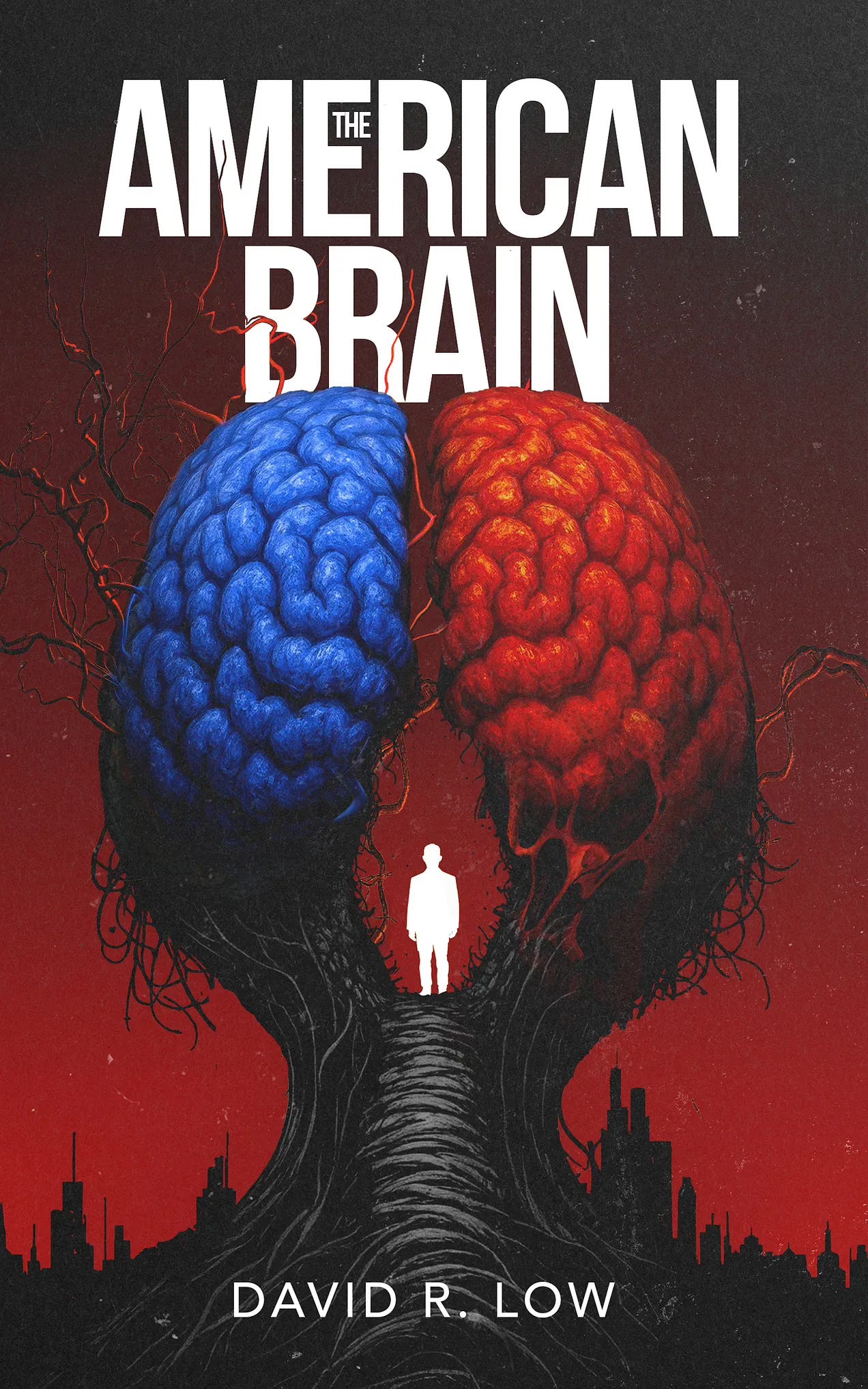
In The American Brain we follow a young scientist, Akseli, who believes he has found a biological explanation for America’s collective behavior. His discovery, however brilliant and compelling, is quickly dismissed and then overtaken by the events that follow.
The story unfolds over several years and decades, tracing a slow, familiar escalation that mirrors what we’ve already witnessed in recent years.
One line in the book does more work than pages of explanation:
“If they can come here illegally, they can leave here illegally. Fuck ’em.”
What makes this sentence disturbing is the logic behind it. If rights are no longer universal principles, they become conditional privileges you get to keep only as long as your existence aligns with the dominant narrative.
The moment you become inconvenient, you lose your rights.
Millions of Americans openly identify with statements like this. Jordan Klepper has heard them countless times during his interviews at MAGA rallies. What’s striking isn’t the hostility itself, but how rarely people seem to follow their own logic to its conclusions.
This isn’t caused by ignorance but by a worldview built on a rigid division between “us” and “them,” where belonging determines virtue and exclusion feels justified. Once that line is drawn, stripping rights from the other side no longer appears extreme, but necessary.
That kind of logic doesn’t stay confined to rallies or slogans and so it becomes the dangerous social dynamic we are seeing. It leaks into institutions, policies and everyday interactions reshaping what people are willing to tolerate and consider “normal”.
The story has its limits. The author’s attraction to over-the-top imagery is evident, and for most of the book it works. Excess amplifies the discomfort and mirrors the escalation the novel wants to expose.
The final chapter, however, feels different. It leans heavily into spectacle, as if written more to indulge the author, and perhaps the reader, than to deepen the reflection on society that came before. The result is an ending that risks undermining the seriousness of what the book has been building.
You can’t take it entirely at face value. But after speedrunning through a collapse this relentless, maybe that excess is also the only ending that makes sense.
What makes The American Brain unsettling is its familiarity. Nothing in it feels truly alien. The logic, the language, the justifications are already part of everyday discourse. The book doesn’t predict the future as a distant possibility, but as an inevitable trajectory rooted in the present.
That’s why it’s hard to dismiss it as exaggeration or satire. The question is no longer whether the book goes too far, but how far we already are.
Maybe that’s the real discomfort it leaves behind, not shock, but recognition.
Disclosure: I discovered The American Brain through a Substack article written by the author. After reaching out, I received an advance reader copy. If interested 👇🏻

This piece reflects my own reading of the book.
If you found this piece useful or thought-provoking, you can support my writing here.