

Citizens, Soldiers, and the War That Never Ends
How Starship Troopers and The Forever War Expose the Logic of War

You are told that war is necessary.
You don’t hear this all at once, but rather digest it slowly, and suddenly, here we are.
The tree of Liberty must be refreshed from time to time with the blood of patriots and tyrants. — Thomas Jefferson, 1787
Jefferson wrote this famous sentence in a letter more than two centuries ago, in a world that no longer exists. And yet, it sounds like wisdom, and its logic still holds true today for many.
Our societies have changed beyond recognition, but people have not. War has been repackaged as a means to export freedom, create stability, and guarantee security. Of course, the true motives, hidden in plain sight, are usually economic.
In recent months we have been watching an unprecedented spectacle in the news where a certain president announces an interest in a certain country in the name of the values mentioned above. A few hours or days later, more comments or posts are made by the same person, where the language slips, unhinged as he is, revealing the truth: it’s about oil, resources, influence, prestige. If you read between the lines, it’s less about what will make the nation “great again” and more about pleasing his narcissistic ego.
It’s a scandal. Topped only by the next crisis. And the next one. And the next one.
Is this violent cycle necessary and therefore inevitable? Is that really all history has to teach us? Is war the only mechanism through which societies reset themselves and achieve new heights?
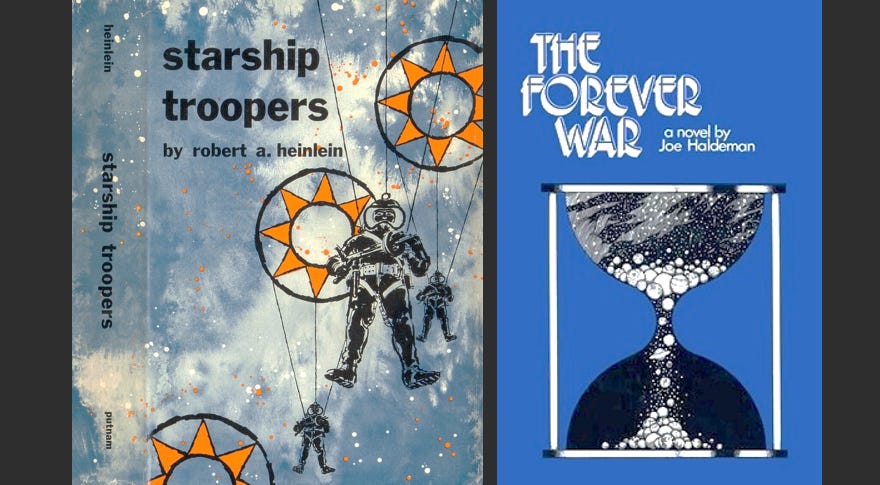
Two of the most iconic works of military science fiction offer a useful lens: Starship Troopers and The Forever War.
Robert Heinlein’s Starship Troopers was published in 1959, at a time when discipline, duty, and militarized citizenship were seen as antidotes to moral decline (the irony!). Joe Haldeman’s The Forever War, published in 1974, emerged directly from the shadow of Vietnam, written as a protest against a war that seemed fundamentally meaningless.
The Mobilization
War is serious business.
Throughout recorded history, warriors have held a special place in most societies. From the citizen-soldiers of ancient Greece and the legions of Rome to the feudal knights of medieval Europe and the samurai of Japan, military service has been closely tied to political power, social status, and, most importantly, civic identity.
Societies transform, sometimes radically, but the need to enforce rules does not disappear. This role has consistently fallen to institutions capable of applying “organized violence” effectively.
If you benefit from that force, you are expected to support it. If you do not participate directly, you contribute indirectly. Taxes. Labor. Consent. Silence.
Violence, naked force, has settled more issues in history than has any other factor, and the contrary opinion is wishful thinking at its worst. — Starship Troopers, 1959
In Starship Troopers, society is arranged by default in a military architecture, suggesting that survival in the space era is tied to a rigid hierarchy. Citizenship is conditional on service.
In The Forever War, mobilization is framed as a reasonable reaction to a threat. Unlike in Starship Troopers, it appears to be specific, and limited in scope. It doesn’t stay that way.
Infrastructure designed for constant emergencies reshapes a society around crisis itself. In that vacuum, the war economy emerges as a substitute for institutions that no longer function.
This creates a self-sustaining positive feedback loop. The real circular economy. Threats justify escalations, escalations manufacture new threats, and the system feeds on itself.
A Day in the Life
Whether you are Johnny Rico or William Mandella, the harder you train, the further you drift from civilian life. Despite your rank, you are not the guy at the wheel, but the tiniest cog of a machine nobody fully understands. You are expendable.
They tell you to jump, you jump.
Initial resentment towards the hardships endured in training is quickly overcome until the protagonist of Starship Troopers is another fanatic soldier. The whole character arc is a story of indoctrination, sort of Full Metal Jacket meets a coming-of-age drama.
You are living a perpetual present where war permeates everything. Battles happen but they don’t matter. You are looking forward to the next drop. You found a family in your battalion and this continuity becomes your driving force.
The Forever War takes a very different approach. For starters, the protagonist is selected for academic aptitude. Soldiers’ work is presented as clean, rational, and precise. There is a constant feeling that you are preparing for a decisive mission that will topple the scale and end the war. You will go home and back to your life.
Instead you left to face the vastness of space. The immense distances involved stretch time to a point that every mission, from Earth’s perspective, takes centuries.
Every time William Mandella goes back to base, humanity has evolved in stranger ways. Fragmentary information arrives scattered in time as well. New plan, new tactics to defeat the enemy. But the enemy changes too between engagements, making every one of them unpredictable.
Whatever started the war is forgotten.
The Reward
The higher the risk, the higher the reward.
In Starship Troopers, service has no fixed length. You enlisted to get citizenship but there is no guarantee you will ever get it. The reward remains just far enough away to justify the next sacrifice, and what better way to boost morale than offering something noble, but not fully defined, as a reason to keep fighting?
The noblest fate that a man can endure is to place his own mortal body between his loved home and the war’s desolation. — Starship Troopers, 1959
You need to fully commit, as an act of faith.
Only the dead have seen the end of war. — George Santayana (1922)
In The Forever War, the reward is money. Unimaginable vast amounts of it. But, due to time dilation, there is nowhere to spend your riches that feels like home. The only option left is going back to the only family left that will always welcome you.
The Long View
While Starship Troopers could be considered an implicit critique of some absurdity of military life, it still glorifies the soldier’s role and the war effort itself. It’s a fun read, but it doesn’t provide the right perspective to capture the scale or extent of what society has become (or how) in that reality. We must take for granted that a militaristic society is the natural structure of the space era.
The Forever War is an explicit critique of war.
There are a couple of points that are difficult to miss.
The most important fact about the war to most people was that if it ended suddenly, Earth’s economy would collapse. — The Forever War, 1974
War allows for a new “world order” to be in place. In this context, peace becomes a threat to stability.
It also perfectly translates what most veterans go through returning home after their deployment ends. There is no use for them in a civilian society that changed without them.
At last the war ends. Unceremoniously. After a thousand years, it’s proven that the conflict was pointless. The impossibility of communicating with the alien race led to a false interpretation of a probe as a missile. The whole escalation, on both sides, out of fear. We struck first. The rest is history.
Across the world, states that claim to be preparing for peace are investing as if war were inevitable. Once war becomes administration, whether the threats are real or imagined, opting out of it stops being a choice. Decisions are made by a few, but the risks are paid by all.
Does war define us?
It depends on who you are.
You can belong to it, like Rico.
You can survive it, like Mandella.
If you found this piece useful or thought-provoking, you can support my writing here.
"In The Forever War, the reward is money. Unimaginable vast amounts of it. But, due to time dilation, there is nowhere to spend your riches that feels like home. The only option left is going back to the only family left that will always welcome you."
This , more than anything, was what stuck out to me about this book. A very profound sense of loneliness and emptiness. I love how throughout the enemy is always at a distance. We don't see them. They essentially don't matter. The enemy is time itself.